From January 18 to 21, the inaugural IEEE Power & Energy Society (PES) International Meeting was held in Hong Kong, China. The meeting was jointly organized by IEEE Power & Energy Society and Research Centre for Grid Modernization at the Hong Kong Polytechnic University. Under the theme "Global Power and Energy Systems Resilience: Leveraging Collaborative Expertise," the meeting brought together academicians, renowned scholars, and industry leaders from the global energy and power sector. Mr. Liu Zehong, Executive Vice Chairman of GEIDCO, was invited to attend the meeting and delivered a keynote speech on "Challenges and Opportunities of Distributed New Energy" at the CEO Forum.
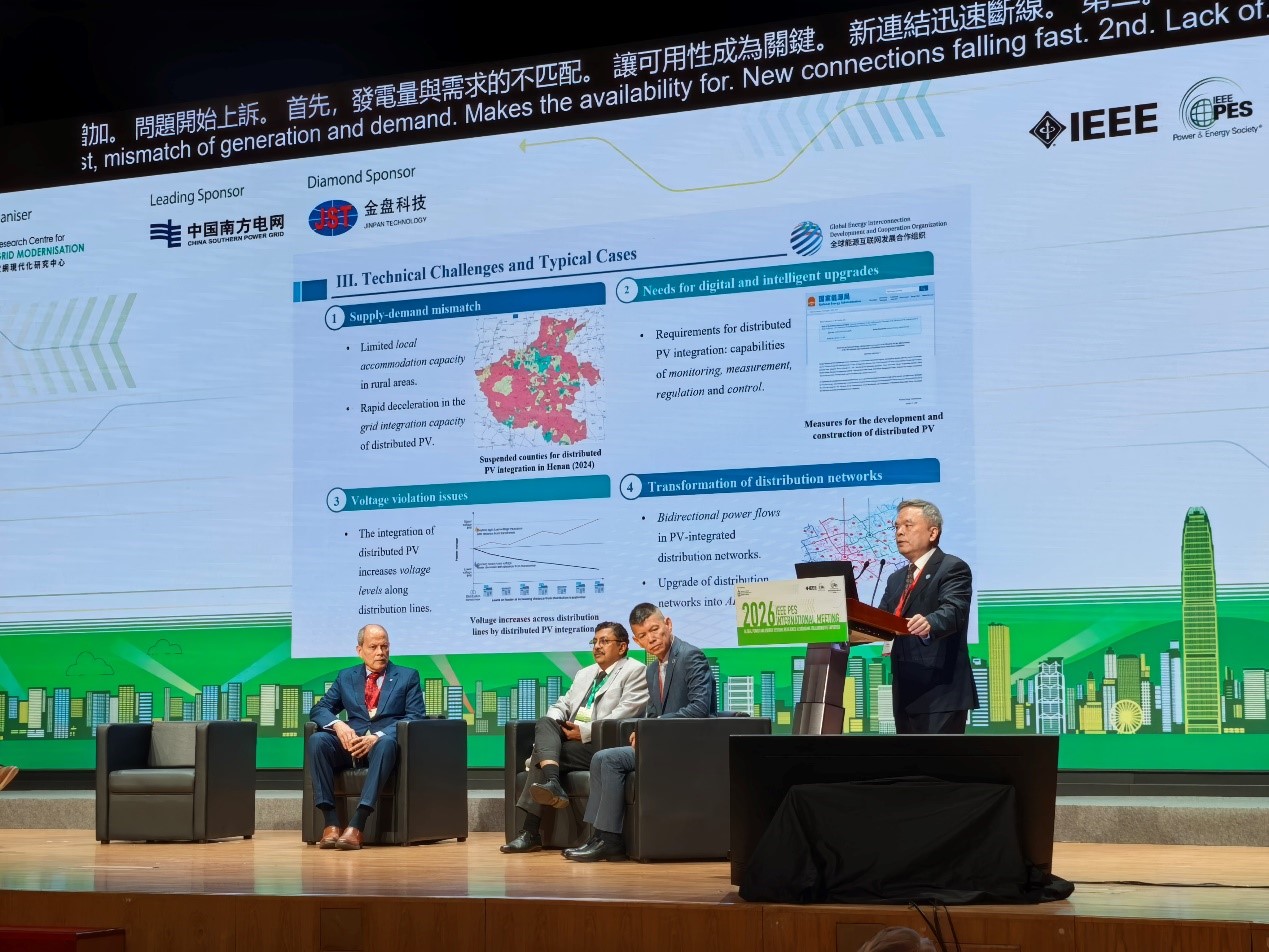
Mr. Liu noted that in recent years, China has steadily advanced its green and low-carbon energy transition, following a dual-track approach that develops both centralized and distributed new energy. Wind and solar installed capacity has grown rapidly. As distributed new energy grid connections continue to expand, new challenges have emerged in grid integration, consumption, and operational control. China has adopted tailored solutions using various new technologies and models. For grid integration and consumption, distributed solar has been widely incorporated into end-use electrification and decarbonization efforts such as zero-carbon villages, zero-carbon industrial parks, and zero-carbon islands, thereby expanding local consumption capacity. For digital and intelligent upgrades, data connectivity has been established across systems, and intelligent control for distributed solar at the transformer area level have been developed, enabling minute-level monitoring and control from the dispatch side. For voltage regulation, solar terminal control devices with built-in local voltage regulation functions have been developed to enable voltage control at users' grid connection points. For distribution network upgrading, technologies such as flexible DC have been deployed to improve network structure and enable flexible control and transfer of distributed solar power flows.
Mr. Liu stated that China has put forward an updated Nationally Determined Contribution target, striving to reach 3.6 terawatts of total installed wind and solar capacity by 2035. All types of centralized and distributed new energy will need to maintain a development pace comparable to the present. According to GEIDCO research, China's national rooftop solar potential is approximately 2.6 terawatts, and in the long term, distributed solar in central and eastern China could support about 10% of electricity demand. Going forward, new energy development will continue to follow a dual-track approach, leveraging west-to-east power transmission, north-to-south power supply, and offshore power delivery inland to meet load demand in central and eastern China.
The IEEE Power & Energy Society has over 42,000 members worldwide, covering all fields of the power and energy industry, and is a leading global provider of scientific and engineering information in power and energy.